
Why I am not afraid of the “singularity”: It will never ever happen!!
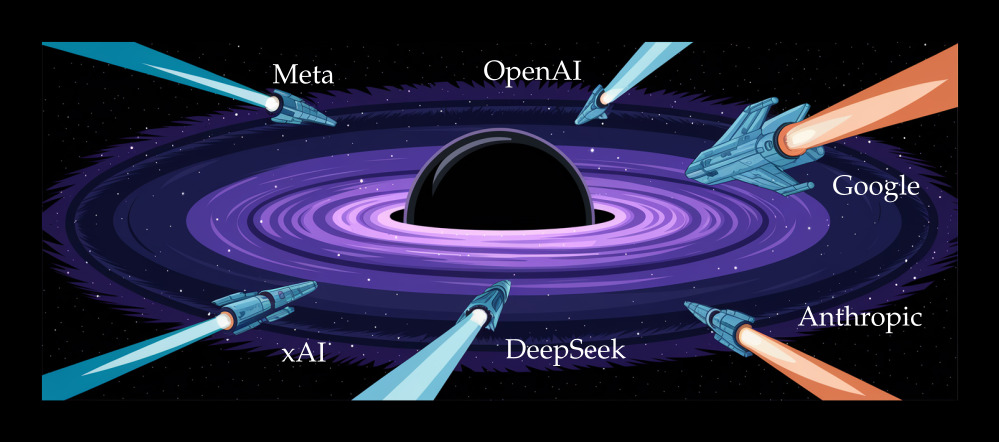
The primary story I hear about AI from the Silicon Valley cult, is that eventually AI will exceed human intelligence, start reprogramming itself recursively, and put humans in danger by not needing them. You might have heard the “AI 2027” hypothesis, or the other scary stories put out by these technofascist cultists.
It’s the primary belief of the AI industry that this will soon happen. It’s the reason why venture capitalists and hyper scalers are going into debt trying to implement their data center build out despite all evidence that there will never be a positive return on investment for these now exceeding $2 trillion capital spending sprees. Why invest in an industry if there is no profit?
But according to the AI industry, there WILL be profit, and lots of it, if they can reach AGI aka “The Singularity”, and that could be any day now…
It’s all a myth and here’s the proof.
The reason these stories exist is because large language model computation is expensive and companies like OpenAI and Anthrop/c need billions to continue their “research”, the stated goal from the beginning is AGI or artificial general intelligence, because “whoever controls AGI controls the world”.
Except they refuse to define AGI, so I will: When any AI company fires all their human programmers because they don’t need them anymore, they will have reached AGI, because AGI will program itself better than any human can.
I guarantee these con-men will declare AGI well before that happens. Especially since it is far more likely that OpenAI will lay off all their engineers soon, not because they reach AGI, but because they are out of money.
The thing is, I knew AGI would never happen. I’ve known it since I read my favorite book Gödel, Escher, Bach: An Eternal Golden Braid by Douglas Hofstadter which spent some time on this topic, though the book is mostly about other things. It led to me learning theoretical computer science while in college.
The first thing I learned is the Church-Turing Thesis developed somewhat separately by Alonzo Church in the US, and Alan Turing in the UK. Between them they developed a model of computability that divides what can be computed, and what can’t. This was developed in the 1930’s before digital computers even existed.
An example proposed by Alan Turing is the “Halting Problem”, a class of recursive computation that cannot exist using a trick that Kurt Gödel used to prove the incompleteness of math. Turing proved computation will always be incomplete.
All of this was outlined by Hofstadter in his 1979 book, which I read around 1989. The book changed how I think about many things: Logic, programming, game design, and what can and cannot be done via computer. Hofstadter himself shares my opinion on AI chatbots as this 2023 essay he wrote explains.
LLMs have to obey the Church-Turing limits of computability
Here’s my thesis: LLMs usefulness is restricted by what is computable, just like every computer programming system or architecture had to since the 1940’s when they were first developed. I know of no known examples of LLMs breaking the rule.
But people try all the time. In fact the #1 use of generative AI chatbots is “Therapy / Companionship” according to the Harvard Business Review, and I bet the vast majority of the questions asked in this category are incomputable. Chatbots give answers because they are programmed to, and they either search their training data looking for an answer, or they fall back on word guessing to come up with an answer that either doesn’t make sense, or is factually wrong.
If you are using a chatbot to be your boyfriend or girlfriend, they will always lie to you and flatter you, which sounds like real companions if you think about it. There’s even a character.ai version of me. I didn’t make it and I don’t endorse it, but it’s crazy to me that it exists.
“But what about programming? LLMs are really good at writing software, surely that’s something that’s not computable?” Nope, software to help people write software has been around since the 1980’s when CASE (computer aided software engineering) became a thing. Writing software with no bugs, mistakes, or security holes is non-computable (see the Halting Problem), but machines writing software that at least works is computable, and always has been.
Chatbots have been a thing since Eliza came out in the 1960’s, and have gotten more sophisticated over the decades. I played with another one called Alice for a while in the 2000’s. LLMs are making much more sophisticated chatbots, but they are still giving nonsensical answers like the non-LLMs did.
The real breakthrough that LLMs have made is that they have mostly solved the “natural language problem”. The giant room sized computers built in the 1950’s were built to translate Russian text into English using simple dictionary word replacement, it was important during the Cold War. The results were mostly nonsense. Computer translation has been a major goal ever since. This is what’s known as the “natural language problem”.
Back in the 2000’s we like to play a game with Google Translate to take song lyrics, translate to another language, say French, translate the French translation to Mandarin, repeat a few times until you translate back to English and post the results on the forum, and see who could name the original song.
The game no longer works, the LLM based translators are too good. Being able to say what you want in plain English is the real strength of LLM based computing, but that is not good enough for the Silicon Valley cultists. They want LLMs that can answer back with “correct” answers, and we are no where close to achieving that.
I wanted to write an essay on why the Church-Turing thesis and the Halting Problem disprove the possibility of AGI or the Singularity, but someone already has and shared it in a video essay that is easy to understand.
So basically, the “AGI” goal that the AI enthusiasts have been predicting will come “any time now” will require a different kind of technology that doesn’t exist yet. What we would need is a technology that is “sentient”, that models the human brain.
The current popular theory is that if we build an LLM complex enough it will gain “sentience” and that this sentience will get us quickly to AGI. This is based on the biological observation that humans are sentient, and we got that way biologically by observing the world through our five senses since we were born. Babies start with incomplete consciousness at birth, then gain self awareness at around 14 months. So all we have to do is simulate this same development in LLMs.
This has been theoretical for several decades. We can emulate the behavior of a nerve cell computationally, so why not emulate an entire brain? LLMs are literally “neural networks” designed to do just that. Surely we can wake up a simulated conscious in a complex enough LLM, can’t we?
No we can’t because…
The Emperors New Mind: Consciousness is Quantum, and quantum computing is decades away
Another book I read is The Emperor’s New Mind: Concerning Computers, Minds and The Laws of Physics by Roger Penrose (1989), which presented a theory that artificial intelligence cannot become conscious because consciousness is a function of quantum physics. Penrose won a Nobel Prize in physics, and was a professor at Oxford with Stephen Hawking so he knows his physics. His theory lacked a lot of evidence, despite a top notch physics background, he was not a biologist, so his expertise on the brain was limited.
But a biologist named Stuart Hameroff read his book and said Penrose was on to something. A collaboration led to the 1994 book Shadows of the Mind: A Search for the Missing Science of Consciousness. This book proposed how a part of each brain cell contains microtubules which are small enough to make quantum physics interaction with the brain possible, but science requires experimental proof, and they didn’t have it yet.
For decades this theory was dismissed as “fringe” science. And then a simple experiment conducted at Wellesley College in 2024 and verified this year (2026) proved Penrose and Hameroff correct. This is also covered in an easy to follow video so I don’t have to spell it out for you.
What does this mean for LLM driven generative AI? Consciousness or sentience will not “magically” happen, because LLMs are not quantum.
The current working theory is that if we make an LLM complex enough, it will achieve consciousness or sentience on its own via a recursive process. A quantum consciousness theory completely destroys the consciousness through complexity theory.
The best LLMs can ever hope for is the emulation of consciousness, and that is decades of hard expensive work. AI companies were trying to avoid emulation because of how tedious it is to do. With consciousness proven to be quantum, things have to be done the long hard expensive way.
So, I’m not afraid the AGI singularity will happen anytime soon, and neither should you.
Humans will be in charge for a lot longer.

